By Ntambo Mabuza
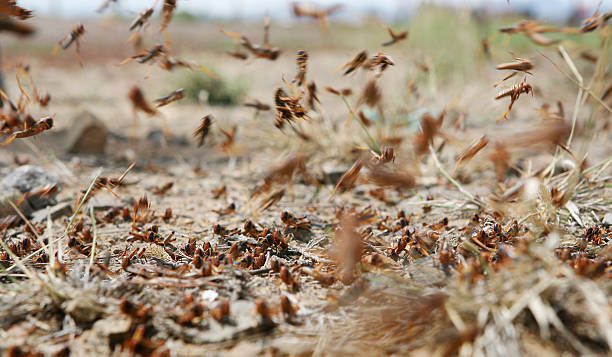
For many, news of a locust outbreak might evoke the biblical story of God unleashing a swarm of locusts upon Egypt. As one of ten plagues brought on by Pharaoh’s refusal to free the Israelites from bondage, the plague of locusts turned croplands into deserts and decimated the nation’s food systems, leading to mass starvation. While modern outbreaks are far from biblical proportions, they are not as rare as many might think. In South Africa, brown locust swarms are endemic to the semi-desert regions of the Northern Cape Karoo but can migrate to other parts of the country if the right conditions exist.

Between September 2021 and early 2022, South Africa experienced one of the most severe brown locust infestations in decades. According to AgriSA archives, over 23 million hectares of land were affected, about 90% of which was agricultural. Control measures at the time included community monitoring, aerial spraying, and other interventions, costing the Department of Agriculture and Land Reform around R80 million.
Between September 2021 and early 2022, South Africa experienced one of the most severe brown locust infestations in decades. According to AgriSA archives, over 23 million hectares of land were affected, about 90% of which was agricultural. Control measures at the time included community monitoring, aerial spraying, and other interventions, costing the Department of Agriculture and Land Reform around R80
million.
While the Northern Cape remains especially prone to locust outbreaks, AgriSA’s Janine Byleveld warns that without effective management, the combination of summer rains, heatwaves, and strong winds could trigger migrations similar to those experienced in 2021/2022. She explains that brown locust outbreaks typically follow two- to five-year cycles and confirms that early signs of renewed activity are already appearing in the province.

To strengthen preparedness, last week AgriSA launched a digital data-capturing platform as part of a multi-stakeholder effort to improve the management of brown locust outbreaks nationwide. The platform allows farmers, district locust officers, and response teams to log sightings and track swarm movements in real time, which will enable the swift detection and containment of locust outbreaks.

“Over the last decade, AgriSA and its members have built a strong working relationship with authorities to manage outbreaks,” says Byleveld, AgriSA’s project spokesperson. Byleveld explains that since August 2025, AgriSA has been engaging with the Directorate: Climate Change and Disaster Risk Reduction Migratory Pest Section (Southern Region) and the Department of Agriculture to strengthen coordination and operational readiness.
“AgriSA has convened provincial coordination meetings to align all stakeholders and emphasises the importance of collaboration, welcoming further participation to strengthen collective management efforts. The organisation remains committed to working with government and industry partners to enhance South Africa’s locust
management systems, safeguard agricultural production, and build rural resilience,” Byleveld adds.
The introduction of this application marks a significant leap forward in early detection, coordination and rapid response by enabling users to:
Log locust sightings with GPS coordinates and photographs.
Track the spread and movement of swarms.
Help provincial and national teams prioritise high-risk areas.
Support the targeted allocation of equipment, resources, and personnel.

“This tool transforms how we manage locust outbreaks—from reactive to proactive. By empowering those on the ground with real-time information, we can mobilise resources faster and reduce crop losses,” according to Byleveld.
The farming community and the public can report sightings via WhatsApp: +27 79 467 0702, which will guide users in submitting locust locations and other details.