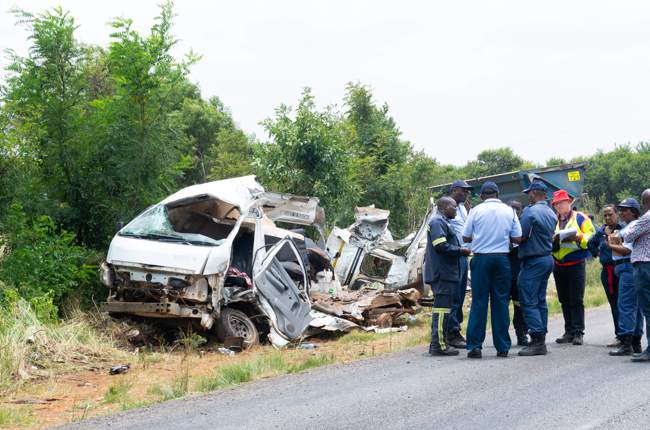
Last month, dashcam footage of the tragic Vanderbijlpark crash that claimed the lives of 14 schoolchildren circulated widely, prompting shock, grief, and difficult conversations. Beyond the speculation and heartbreak lies an uncomfortable but necessary question: what would you do if you found yourself facing an oncoming vehicle, with nowhere to go?
It’s not a scenario any motorist wants to imagine, yet experts warn that it’s one every defensive driver should be mentally prepared for.
According to Eugene Herbert, CEO of MasterDrive, a possible head-on collision should never be dismissed as “unlikely”.

“A possible head-on collision is something every defensive driver should always expect and, consequently, be prepared for. Understand and accept mistakes or bad decisions will be made on the road by others,” says Herbert.
He explains that while nothing can guarantee survival, how a driver responds in those critical seconds can significantly reduce harm.
“Drivers must always be prepared for a potential head-on collision and respond in a manner that minimises risk for all road users.”
Instinct vs training, and why reactions matter
When danger appears suddenly, instinct often takes over and that’s not always helpful.
In the Vanderbijlpark scenario, an overtaking vehicle entered the wrong lane, creating a direct collision path. Herbert notes that drivers often react by swerving sharply or braking hard.
“These techniques, however, are often at ‘war’ with your instinctual reaction, which are often not the safest course of action.”
One common instinct is to fixate on the oncoming vehicle. “Drivers naturally steer toward the object they are staring at,” Herbert explains. The trained response is to consciously look away and steer towards the safest available space, usually the left shoulder of the road.

Another instinct is to slam on the brakes.
“Stop accelerating and gradually apply brakes,” advises Herbert. “Once speed is safely reduced you can start manoeuvring into a safe position.”Sudden braking can cause loss of control, particularly in vehicles without ABS, or create secondary collisions.

If there’s nowhere to go
What if the shoulder is narrow, or there are trees, poles, or ditches?
“It is still recommended to steer toward the left shoulder to avoid a direct head-on collision,” says Herbert. “Aim to hit obstacles from the side in a glancing blow rather than a full-frontal crash.”
It’s a difficult reality, but physics matters: angled impacts are generally more survivable than head-on crashes.
A collective responsibility
The tragedy has reignited calls for improved training, particularly for scholar transport drivers.
“MasterDrive supports the calls from society and proposals from government for scholar transport drivers to undertake greater training. This is the first step in preventing needless loss of young, innocent lives on our roads,” Herbert says.